


⚡ BREAKING NEWS
● BREAKING Accused Charlotte Killer Ruled Mentally Incompetent for Trial Gilgo Beach Suspect Pleads Guilty to Eight Murders Fuller Wins Georgia Special Election, Boosts GOP Majority American Journalist Freed in Iraq After Week-Long Captivity <p><strong>Fairside News is evolving.</strong> As we approach our one-year anniversary, we’re expanding into real-time breaking news powered by global RSS feeds, while enhancing our platform with richer visuals—now featured in nearly 80% of articles—and improved AI-driven workflows.</p> <p>What began as timely reporting has grown into a faster, more dynamic news source, with readership approaching 700,000 article views. Stay informed with clear, fact-based coverage and perspectives from both sides of the aisle.</p>
Sponsor Advertisement
White House Reviews NATO Troop Deployments Based on Iran Support
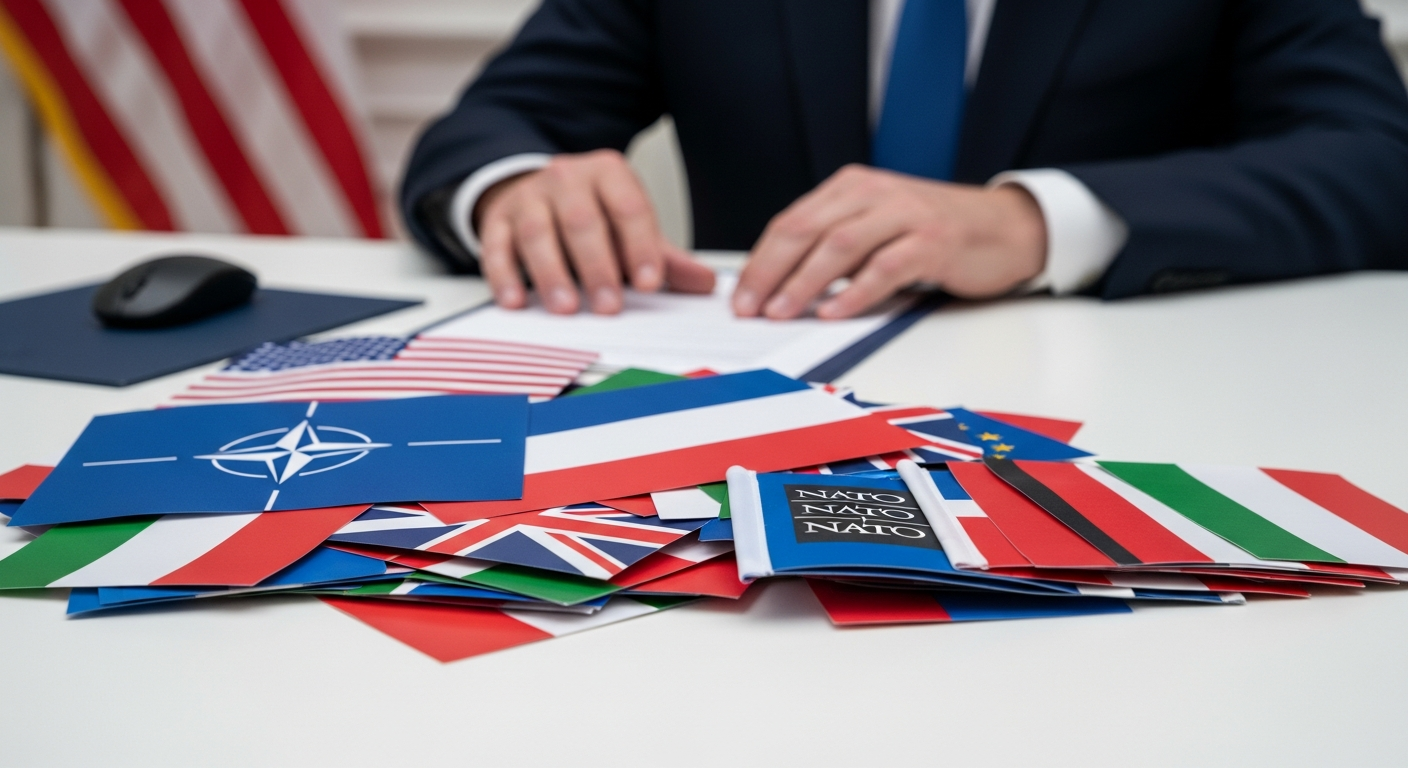
AI-generated image for: White House Reviews NATO Troop Deployments Based on Iran Support

White House Reviews NATO Troop Deployments Based on Iran Support

The White House is reviewing options to reorganize U.S. troop deployments and military assets within NATO, based on member nations' support during the military campaign against Iran. Nations showing solidarity may host more U.S. presence, while those not supporting could face withdrawals.

The Trump White House is reportedly reassessing the deployment of American troops and military assets across NATO member nations, with a focus on how allies responded to the United States' military campaign against Iran's Islamist government. This review, detailed in a Wall Street Journal report citing unnamed administration officials, aims to hold alliance members accountable for their conduct during Operation Epic Fury. The assessment suggests that countries demonstrating solidarity with Washington could see an increased American military presence, while those perceived as unsupportive might face a reduction or withdrawal of U.S. forces.

According to the report, Greece, Lithuania, Poland, and Romania are among the nations identified as having shown strong support for Washington throughout the Iran operation. These countries are now potentially in line to host a larger contingent of American military personnel and equipment. Conversely, Germany and Spain are reportedly facing the prospect of a reduced U.S. military commitment within their borders, including the potential withdrawal of American troops.

Spain's Socialist Prime Minister Pedro Sánchez drew particular attention for his opposition to the Iran conflict. Sánchez not only denied U.S. military access to Spanish bases but also prohibited American Air Force planes from crossing Spanish airspace en route to the Middle East. The friction between Washington and Madrid extends beyond the Iran operation, however. Spain was reportedly the only European ally in NATO to flatly refuse President Trump’s call for members to commit five percent of their GDP to national defense. Spain has also consistently failed to meet NATO’s minimum defense spending benchmark of two percent of GDP.

Germany, while allowing U.S. forces to use its bases for Iran operations, publicly expressed its displeasure with the conflict. Chancellor Friedrich Merz accused President Trump of initiating a "massive escalation with an open outcome" and stated definitively, "this is not our war." German President Frank-Walter Steinmeier echoed this sentiment, branding the entire operation a "disastrous mistake" by America and alleging that Washington had violated international law.

Britain, traditionally regarded as a steadfast U.S. partner, also faced scrutiny. President Trump publicly referred to the United Kingdom as America’s "once great ally." Prime Minister Sir Keir Starmer initially denied American forces full access to British bases before adjusting his stance to permit only defensive missions from British soil. France and Italy likewise drew criticism for shutting their airspace to American aircraft and declining invitations to join an international maritime coalition designed to secure the Strait of Hormuz during the conflict.

President Trump has taken to Truth Social to air his grievances regarding the alliance's response. On Wednesday, he wrote: “NATO wasn’t there when we needed them, and they won’t be there if we need them again. Remember Greenland, that big, poorly run, piece of ice.” This public statement underscores a long-standing point of contention. European analysts have previously suggested that President Trump’s interest in acquiring Greenland strained relationships with European leaders, potentially pushing them further from Washington’s orbit. Those within President Trump’s circle, however, argue that the behavior of NATO allies during the Iran conflict reinforces the strategic importance of independent access to territories like Greenland, particularly in the event of future confrontations with powers like Russia or China.

Republican skepticism regarding NATO, historically centered around President Trump, appears to be broadening. Former Secretary of State Mike Pompeo and former White House Press Secretary Ari Fleischer have recently questioned the value proposition of the alliance for the United States. In response to escalating tensions, NATO Secretary General Mark Rutte, who has often been seen as a more sympathetic voice for President Trump in Europe, visited the White House. Speaking to CNN, Rutte acknowledged that he "could see" President Trump’s disappointment with the alliance but countered by noting that the "large majority of European nations have been helpful" throughout the conflict. The ongoing review signals a potential shift in the architecture of U.S. military presence in Europe, tying future deployments directly to perceived loyalty and support for American foreign policy objectives.


Advertisement

The Flipside: Different Perspectives

Progressive View

Progressives view the White House's approach to "punishing" NATO allies as potentially counterproductive and damaging to long-term collective security. Emphasizing multilateralism and diplomatic solutions, this strategy risks alienating crucial partners and weakening the very alliances designed to promote global stability. While accountability for defense spending is a valid discussion, linking troop deployments to specific military operations, especially those initiated without broad international consensus, could undermine the foundational principles of NATO as a defensive alliance. Such actions could inadvertently push allies into less cooperative postures, making future collective action against genuine threats more difficult. Rather than coercive measures, a progressive approach would advocate for empathetic dialogue, understanding the diverse geopolitical contexts of allied nations, and seeking common ground through diplomacy. The focus should be on strengthening alliances through shared values and collective well-being, not on transactional relationships that demand loyalty to unilateral actions, potentially diverting resources from critical social and environmental challenges.

Conservative View

From a conservative perspective, the White House's review of NATO troop deployments based on allied support during the Iran operation is a necessary and justified measure to ensure accountability and burden-sharing within the alliance. The principle of individual liberty extends to national sovereignty, meaning each nation chooses its path, but consequences follow. For too long, the United States has borne a disproportionate share of the collective defense burden, while some allies have consistently failed to meet their financial commitments, such as the two percent of GDP minimum defense spending target. President Trump’s call for a five percent commitment, while ambitious, highlights the disparity. This review serves as a crucial step towards reasserting American interests and ensuring that U.S. taxpayer dollars and military resources are strategically allocated to partners who actively contribute to shared security objectives. Prioritizing reliable allies and re-evaluating commitments to those who actively undermine U.S. operations aligns with a limited government approach, focusing resources where they yield the most benefit for American security.

Common Ground

Despite differing approaches, there is common ground regarding the importance of a robust and effective NATO alliance for international security. Both conservative and progressive viewpoints recognize the need for allies to contribute equitably to collective defense, even if the specific benchmarks or methods of achieving that contribution differ. There is also a shared understanding that clear communication and dialogue between the United States and its allies are essential for managing expectations and resolving disagreements. Furthermore, all stakeholders generally agree on the necessity of strategically allocating defense resources to maximize their impact against contemporary threats. Constructive discussions on modernizing alliance structures, ensuring efficiency, and fostering genuine partnership, rather than punitive measures, could lead to more sustainable and mutually beneficial outcomes for all NATO members.